
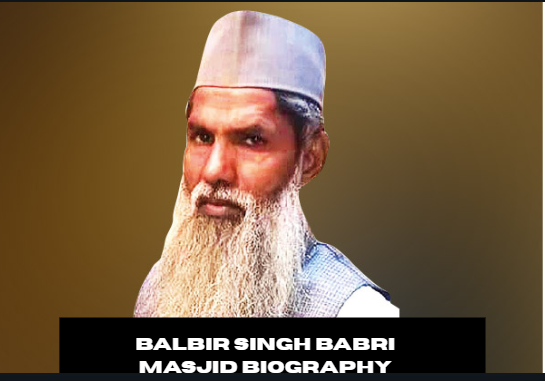
Balbir Singh became widely known for his role in one of the most controversial events in modern Indian history—the demolition of the 16th-century Babri Mosque in Ayodhya on December 6, 1992. His life story later took a dramatic turn, marked by deep personal reflection, a change of faith, and decades of humanitarian work focused on interfaith healing.
Balbir Singh Biography
| Detail | Information |
|---|---|
| Former Name | Balbir Singh |
| Adopted Name | Mohammed Amir |
| Place of Birth | Near Panipat, Haryana, India |
| Tribe / Caste | Rajput (by birth) |
| Religion | Not publicly disclosed (embraced Islam in 1993) |
| Age | Not publicly disclosed |
| Height | Not publicly disclosed |
| Net Worth | Not publicly disclosed |
| Occupation | Social worker, religious educator |
| Known For | Role in Babri Mosque demolition and later conversion |
Who Is Balbir Singh?
Balbir Singh was one of the Hindu volunteers involved in the demolition of the Babri Mosque. He was reported to be the first individual to climb onto the mosque’s central dome, carrying tools used during the destruction. At the time, he was driven by intense ideological convictions shaped by radical political and religious influences.
However, the aftermath of the event triggered a profound internal reckoning that would completely alter the direction of his life.
Early Life and Background
Balbir Singh was born into a Hindu Rajput (upper-caste) family in a small village near Panipat, Haryana, India. His father worked as a school teacher and was known for his admiration of Mahatma Gandhi’s philosophy of non-violence.
Despite his father’s peaceful outlook and support for communal harmony, Balbir’s formative years in Panipat exposed him to hardline ideological movements. During his youth, he began attending drills and training programs organized by the Rashtriya Swayamsevak Sangh (RSS). Over time, he also became associated with Shiv Sena, a political group known for its aggressive nationalist rhetoric.
Alongside these activities, he worked in his family’s loom business.
Role in the Babri Mosque Demolition
On December 6, 1992, Balbir Singh traveled to Ayodhya as part of a large gathering of Hindu volunteers. According to his own later accounts, the atmosphere was charged with fear, anger, and anticipation. Many believed state authorities would intervene, but minimal security around the structure emboldened the crowd.
Balbir Singh stated that he was among the first group to reach the mosque and climbed the central dome, using tools to help bring it down. After returning to Panipat, he was initially welcomed as a hero by some members of the community.
That sense of triumph ended quickly.
Turning Point and Introspection
When Balbir returned home, his family reacted with disappointment and condemnation. Their response shattered the emotional high he had felt. He later acknowledged that he had taken the law into his own hands and violated the principles of the Indian Constitution.
This internal conflict led him into months of isolation and deep self-examination. People around him assumed he had lost emotional stability, but in reality, he was questioning his identity, beliefs, and sense of purpose.
Conversion and New Identity
Roughly six months after the demolition, Balbir Singh encountered Maulana Kaleem Siddiqui, an Islamic scholar based in Phulat village, Muzaffarnagar district, Uttar Pradesh. Through discussions and personal observation, he began reassessing his worldview.
On June 1, 1993, Balbir Singh embraced Islam and adopted the name Mohammed Amir. He described the conversion as a step that brought him inner peace and emotional clarity.
Since then, he has identified himself primarily by his adopted name, although references to his former identity persist in public discourse for historical reasons.
Life After Conversion and Humanitarian Work
After his conversion, Mohammed Amir relocated from Panipat to Hyderabad, in southern India, seeking a quieter environment away from hostility and public pressure.
Over the last several decades, he has focused on constructive acts aimed at reconciliation. He has claimed involvement in the construction or repair of about 90 mosques across India, stating that his long-term personal goal is to help build 100 mosques as an act of atonement.
In addition, he runs a religious school in Hyderabad, where Islamic teachings are shared with interested learners. He has repeatedly stated that he is prepared to accept legal responsibility for his role in the 1992 demolition if required by law.
Views on Reconciliation
In interviews, Mohammed Amir has encouraged Muslims and Hindus to focus on healing, coexistence, and shared progress rather than prolonged hostility. Following the Indian Supreme Court verdict on the Babri Masjid case, he urged Muslims to move forward peacefully and leave matters of justice to lawful institutions and faith.
Religion, Tribe, Age, Height, and Net Worth
Certain personal details about Balbir Singh (now Mohammed Amir) are deliberately kept private. Publicly available sources do not provide verified figures for some aspects of his personal profile.
Frequently Asked Questions (FAQs)
What is Balbir Singh known for?
He is known for his involvement in the 1992 Babri Mosque demolition and his later conversion to Islam followed by humanitarian and religious work.
Did Balbir Singh change his religion?
He embraced Islam on June 1, 1993, after months of introspection and later adopted the name Mohammed Amir.
Where is Balbir Singh living now?
He resettled in Hyderabad, India.
How many mosques has Mohammed Amir helped build?
He has stated that he has helped build or repair about 90 mosques across India.
Is Balbir Singh’s age or net worth known?
No verified public records disclose his age, height, or net worth.
Conclusion
Balbir Singh’s life story stands as a rare and deeply complex narrative of ideological extremism, remorse, and transformation. His journey from radicalization to introspection and long-term humanitarian effort continues to provoke discussion about accountability, forgiveness, and the possibility of personal change.
While opinions differ about his past, his present life reflects an ongoing effort toward reconciliation and spiritual reform—an example that continues to draw attention within India and beyond.
Leave a Reply